
Drench Digest Q&A
All questions have been answered by Animal Health Expert and Veterinarian Annika Ferris.
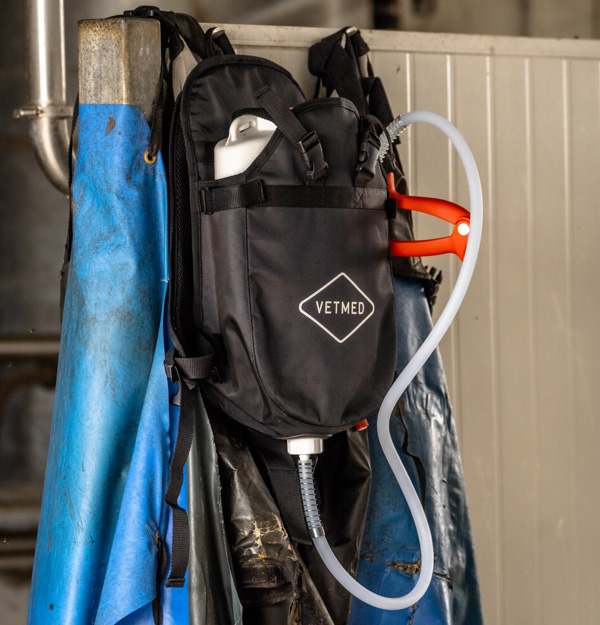
We recommend that each time you set up for drenching, you calibrate your drench gun to the dose you intend to give and with the drench you have selected.
If you are going to be drenching over a period of days, you do not need to calibrate your gun each day, but we recommend that you check your gun for leakages or backflow at the beginning of each session, as these will affect the dose you are giving.
We recommend inspecting the nozzle for damage or rough edges that may injure your stock's mouth.
Once drenching is finished, disassemble your gun from your drench pack and rinse well with warm water.
This is common practice on farm to avoid multiple yardings, however some care needs to be taken when using mineralised drenches. All Vetmed oral drenches are mineralised with Selenium and Cobalt, and Selenium can be toxic when given in excess.
Typically, a selenised vaccine or Selenium + B12 injection is safe when given at the same time as a selenised drench.
However, if selenium is being supplemented by another form, such as in fertiliser, or via water, or lick blocks, or if an injectable selenium has been given in the last 3 months, then we advise you seek advice from your veterinarian before giving minerals and oral Vetmed drench concurrently.
The Selenium provided in Vetmed oral drenches provides supplementation for up to 30 days.
This is a question all farmers should ask.
We recommend taking a 10-day post-drench FEC to assess the efficacy of your drench.
A positive egg count post-drench should prompt an investigation into your drenching procedures and drench choices. As a positive count post-drench is not necessarily a failure, things like dose rate and your drench gun should always be checked first.
The answer to this question depends on many things and will vary greatly from farm to farm and even mob to mob.
The one golden rule is to ensure a MINIMUM of 28 days between drenches. This allows time in the worm life cycle for a population of adult worms not to be exposed to drench and act as refugia.
In situations where larval contamination is low (e.g., on crops, dry summers, clean pastures), the drench interval can be extended well past these 28 days. Faecal Egg Counts (FECs) are a helpful tool in young stock to help determine if a drench is required, or if the time between drenches can be extended.
Drenching too often increases the risk of resistance, whereas allowing FECs to climb too high in young stock can mean lost production and increased pasture contamination.
If no other form of selenium supplementation is given at the same time, an oral selenised drench given at the correct dose is safe to give following selenised fertiliser application.
If you are wanting to include a selenised vaccine or multimineral injection, we recommend you seek advice from a vet regarding your stock’s selenium levels first as excess selenium can be toxic.
At Vetmed we offer both a 1mL per 5kg and a 1mL per 10kg triple combination drench.
Triplemax Oral is a 1mL per 10kg triple combination suitable for both sheep and cattle.
We recommend using this in cattle, but it also offers a more convenient dose for drenching heavier sheep, as the smaller volume dose is easier on both the farmer and the animal. For example, a 70kg ewe receives 7mL of this drench as opposed to 14mL of a 1mL/5kg drench.
Triplemax Sheep Oral is a 1mL per 5kg triple combination developed for sheep.
It was developed for use in sheep (over 20kg) to allow for a more accurate delivery in lambs. For example, a 20kg lamb receives 4mL of this drench as opposed to 2mL of a 1mL/10kg drench. The higher volume leaves less room for over- or under-dosing in this weight range.
For drenching lambs under 20kg, choose a drench that does not contain abamectin, as this can be toxic to small lambs. Such as Triplemax iTape Oral – also in a convenient 1mL per 5kg dose.
We always recommend drenching to the heaviest and not the mob average weight. We do this to avoid underdosing, as this encourages resistance.
However, if your weight range is large i.e 110 - 180 kg, then we recommend drafting out the smallest (i.e those 130kg and less) and dosing those to the heaviest in their mob to avoid them being significantly overdosed.
Another option is to dial down the drench gun when you get to these individuals – BUT always remember to dial it back up after they have been drenched.
Due to the nature of combining drench actives, every drum of drench should be given a good shake before use.
Vetmed drenches have been developed in a unique formulation to prevent significant separation of the active ingredients - shaking up a Vetmed drench is more like shaking up your favourite cocktail, than shaking a tin of paint.
Using the wrong drench in calves under 100kg can cause deaths!
Because calves under 100kg are sensitive to abamectin toxicity, drenches containing this ingredient MUST be avoided.
Choose a combination drench that contains no Abamectin – Combomax Oral is an excellent choice for calves under 100kg as it still contains levamisole to target Cooperia, a common worm in this stock class.
Some pour-on drenches do have good efficacy against lice.
We recommend Moxidectin Pour-on drench.
As lice complete their entire life cycle on the animal, it is important that when targeting lice, all animals are treated at the same time. As we do not recommend blanket drenching of adult stock, those that do not need a drench can be treated with Vetmed’s Delmax pour-on, which provides effective control of both biting and sucking lice and also has a convenient nil milk withholding.